If you’re starting an Etsy shop selling digital products, there’s a question you’re going to run into sooner or later:
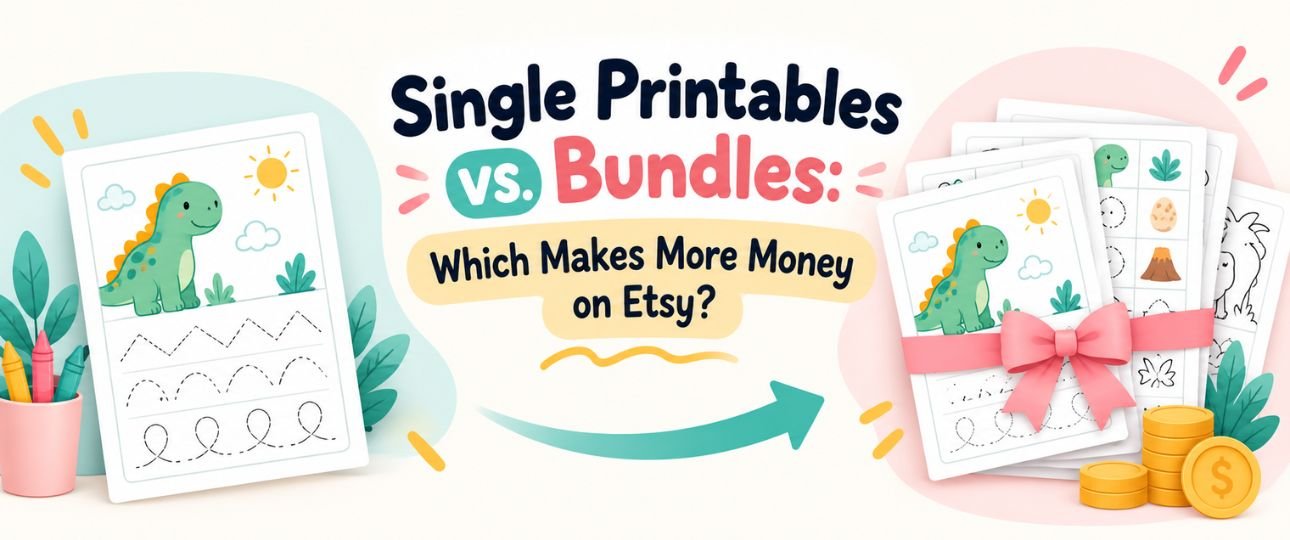
Should I sell my printables individually, or should I combine them into bundles?
At first, selling individual printables seems like the obvious choice.
You create one product, upload it, price it affordably, and move on to the next one.
But then you see other Etsy sellers offering huge bundles containing dozens—or even hundreds—of pages.
And suddenly you start wondering:
Are bundles actually better?
Do customers prefer them?
Can bundles make more money?
Should you stop selling individual products altogether?
The answer isn’t as simple as “bundles are better.”
Both single printables and bundles can play an important role in a successful digital product shop.
The real opportunity comes from understanding when to use each one and how they can work together.
In this guide, we’ll compare single printables and bundles, look at the advantages and disadvantages of each, and build a simple product strategy you can use for your Etsy shop.
What Is a Single Printable?
A single printable is a focused digital product designed to solve one specific need.
For example:
- Printable chore chart
- Dinosaur coloring page pack
- Alphabet tracing worksheet
- Kids’ scavenger hunt
- Printable reward chart
- Weekly meal planner
- Budget worksheet
- Christmas activity sheet
The product might contain one page or several pages, but the main idea is that it addresses one specific use case.
For example:
Printable Dinosaur Coloring Pages
The customer knows exactly what they’re getting.
They aren’t purchasing an enormous collection.
They’re buying one particular product that caught their attention.
What Is a Digital Bundle?
A digital bundle combines several related products into one larger package.
For example, instead of selling:
- Alphabet worksheets
- Number worksheets
- Shape worksheets
- Coloring pages
- Matching activities
separately, you could combine them into:
Ultimate Preschool Learning Bundle
The customer gets several related resources in one purchase.
A bundle could contain:
- 20 worksheets
- 10 coloring pages
- 5 matching activities
- 5 puzzles
- Flashcards
- Reward charts
The exact contents depend on the niche and product.
The important thing is that the products should feel like they belong together.
So, Which One Makes More Money?
This is where we need to get rid of one common misconception.
A bigger product does not automatically mean more money.
And a cheaper single printable doesn’t automatically mean fewer sales.
There are several different ways to measure success.
For example:
Revenue per order
How much does one customer spend?
Number of orders
How many people purchase?
Profit per product
How much do you actually keep after your costs?
Conversion
How many shoppers who view your listing actually purchase?
Customer value
Can one customer purchase more than one product from your shop?
A bundle can potentially increase the value of an individual order because you’re offering more products together.
But individual printables can make it easier for shoppers to enter your shop at a lower price.
That’s why the smartest strategy isn’t necessarily:
Single OR Bundle.
It can be:
Single products + related products + bundles.
Why Single Printables Are So Important
Let’s start with the humble single printable.
It might not look as impressive as a 100-page bundle.
But single products have several advantages.
1. They’re Easier for Customers to Try
Imagine you’re a parent searching Etsy for a dinosaur activity.
You see two options.
Option A
Dinosaur Coloring Pages — $3
Option B
Ultimate Dinosaur Activity Bundle — $18
If you’re not sure whether you like the seller’s style, the $3 product feels like a much smaller commitment.
That’s one of the biggest advantages of individual products.
They can act as an entry point into your shop.
A customer can try one product before deciding whether they want more.
2. Single Products Can Target Very Specific Searches
A single product can be extremely focused.
For example:
Printable Alphabet Tracing Worksheets
or:
Christmas Scavenger Hunt for Kids
or:
Preschool Number Matching Game
The more specific the product, the easier it can be to communicate exactly what the shopper is getting.
Etsy allows sellers to use up to 13 tags and encourages relevant keywords that describe the product. (Etsy Help)
This means individual products can become useful pieces of a broader keyword and product strategy.
Instead of trying to make one giant listing relevant to every possible search, you can create several focused listings.
3. They Give You More Products in Your Shop
Imagine you’ve created 30 individual printables.
You now have 30 potential listings.
Each listing gives you another opportunity to present a product to shoppers.
This doesn’t mean you should create random products simply to increase your listing count.
Quality and relevance still matter.
But a shop with several related products can give customers more ways to discover your work.
Etsy itself notes that digital downloads can help sellers add listings and reach different audiences. (Etsy)
4. They Help You Discover What Customers Want
This is an underrated advantage.
Suppose you create five different preschool products:
- Alphabet worksheets
- Number worksheets
- Coloring pages
- Matching game
- Shape activities
Maybe the alphabet product gets much more attention than the others.
That’s information.
You now have evidence that your audience may be particularly interested in alphabet-related resources.
You can use that insight to create:
- More alphabet worksheets
- Alphabet games
- Alphabet flashcards
- Alphabet coloring
- Alphabet activity books
- An alphabet bundle
So single products can actually become market research for your future bundles.
5. Single Products Can Become the Building Blocks of Bundles
This is where the strategy gets interesting.
You don’t necessarily need to create a bundle from scratch.
You can build it over time.
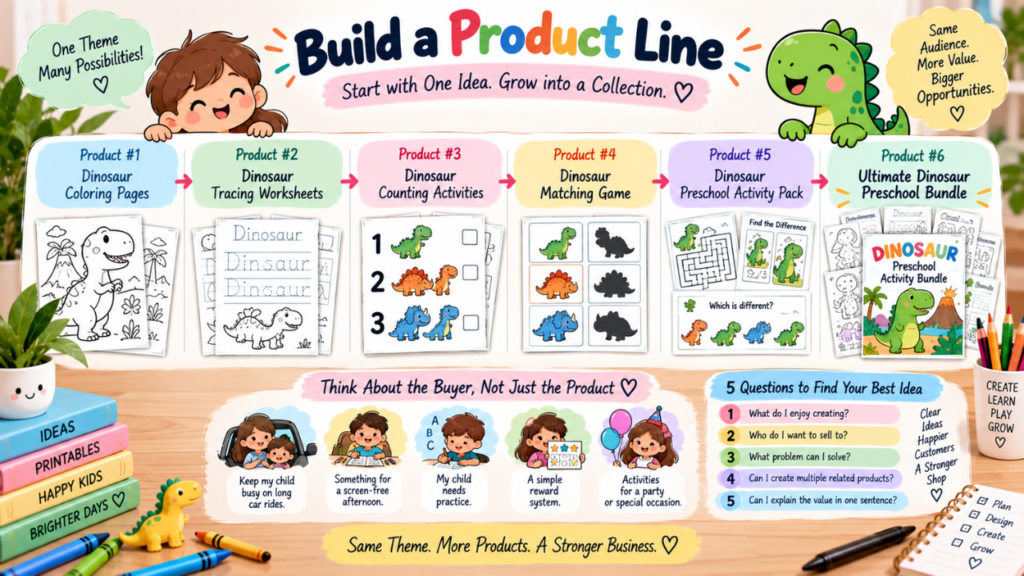
For example:
Product 1
Dinosaur Coloring Pages
Product 2
Dinosaur Tracing Worksheets
Product 3
Dinosaur Counting Activities
Product 4
Dinosaur Matching Game
Product 5
Dinosaur Maze Pack
Then combine them:
Ultimate Dinosaur Preschool Bundle
Now your bundle isn’t a random collection.
It’s made from products you’ve already developed.
The Problem With Selling Only Single Printables
Individual products have advantages, but there are also limitations.
The biggest one is order value.
Suppose your average product sells for $3.
A customer buys one product.
Your revenue from that order is $3 before applicable fees and other costs.
Now imagine the same customer purchases a $12 bundle.
You have generated more revenue from that individual transaction.
Of course, that doesn’t mean the $12 bundle will automatically sell better.
But it shows why bundles can be powerful.
What Makes Bundles Attractive to Customers?
Bundles appeal to a very simple idea:
“I’m getting more for my money.”
Let’s imagine a customer sees these products:
Individual Products
Alphabet Worksheets — $3
Number Worksheets — $3
Shape Worksheets — $3
Coloring Pages — $3
Matching Games — $3
Buying everything separately could cost $15.
Then you offer:
Preschool Learning Bundle
$9.99
The customer may perceive the bundle as better value.
They get more resources while spending less than they would if they bought every product individually.
That perceived value can make bundles attractive.
Bundles Can Solve a Bigger Problem
This is one of the biggest differences between a single product and a bundle.
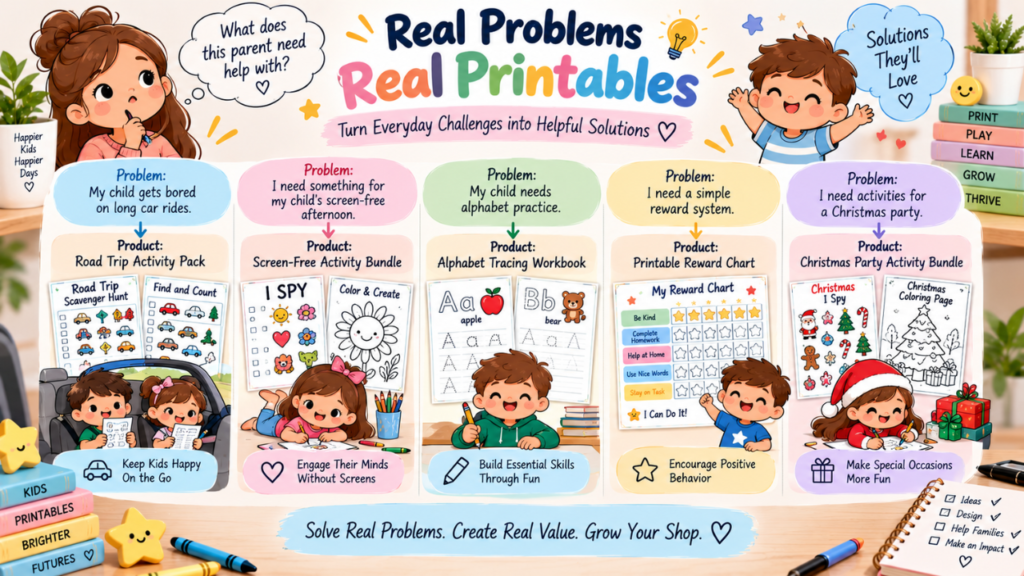
A single product often solves:
One problem.
A bundle can solve:
A collection of related problems.
For example:
Single Product
Alphabet Tracing Worksheets
Problem:
“My child needs letter-tracing practice.”
Bundle
Complete Preschool Learning Bundle
Problems:
“I need activities for letters, numbers, shapes, matching, coloring, and early learning.”
The bundle becomes a more complete solution.
But Bigger Isn’t Always Better
Here’s something I really want you to remember:
Don’t create a 200-page bundle just because you think customers want more pages.
More isn’t automatically better.
A huge bundle can actually become overwhelming.
Imagine a parent buying a “500-page preschool mega bundle.”
They download it.
Then they open the file and see hundreds of pages.
What do they use first?
Where do they start?
Is everything relevant?
A smaller, carefully organized bundle can sometimes feel much more valuable than a massive collection of unrelated pages.
The goal should be:
Maximum usefulness—not maximum page count.
A Good Bundle Should Feel Intentional
Imagine you’re creating:
Halloween Kids Activity Bundle
You might include:
- Halloween coloring pages
- Halloween scavenger hunt
- Halloween bingo
- Halloween word search
- Halloween maze
- Halloween I-Spy
- Halloween drawing activity
These products make sense together.
Now compare that with:
- Halloween coloring
- Budget planner
- Wedding checklist
- Meal planner
- Preschool worksheet
That’s not a bundle.
That’s just several products thrown into one file.
A strong bundle should answer:
“Why would someone want all of these together?”
If you can’t answer that question, the bundle probably needs more thought.
Single Printables vs. Bundles: The Real Difference
Here’s a simple comparison:
| Feature | Single Printables | Bundles |
| Lower entry price | ✅ | Sometimes |
| Easy to understand | ✅ | ✅ |
| Specific problem | ✅ | Sometimes |
| Higher order value | Usually lower | Potentially higher |
| Easy to create | ✅ | Depends |
| Good for testing ideas | ✅ | Less suitable |
| Strong perceived value | Depends | Often |
| Good for upselling | ✅ | ✅ |
| Can become a shop bestseller | ✅ | ✅ |
| Useful for collections | ✅ | ✅ |
| Requires more organization | Low | Higher |
The key word here is potentially.
Neither format guarantees sales.
The Best Strategy: Use a Product Ladder
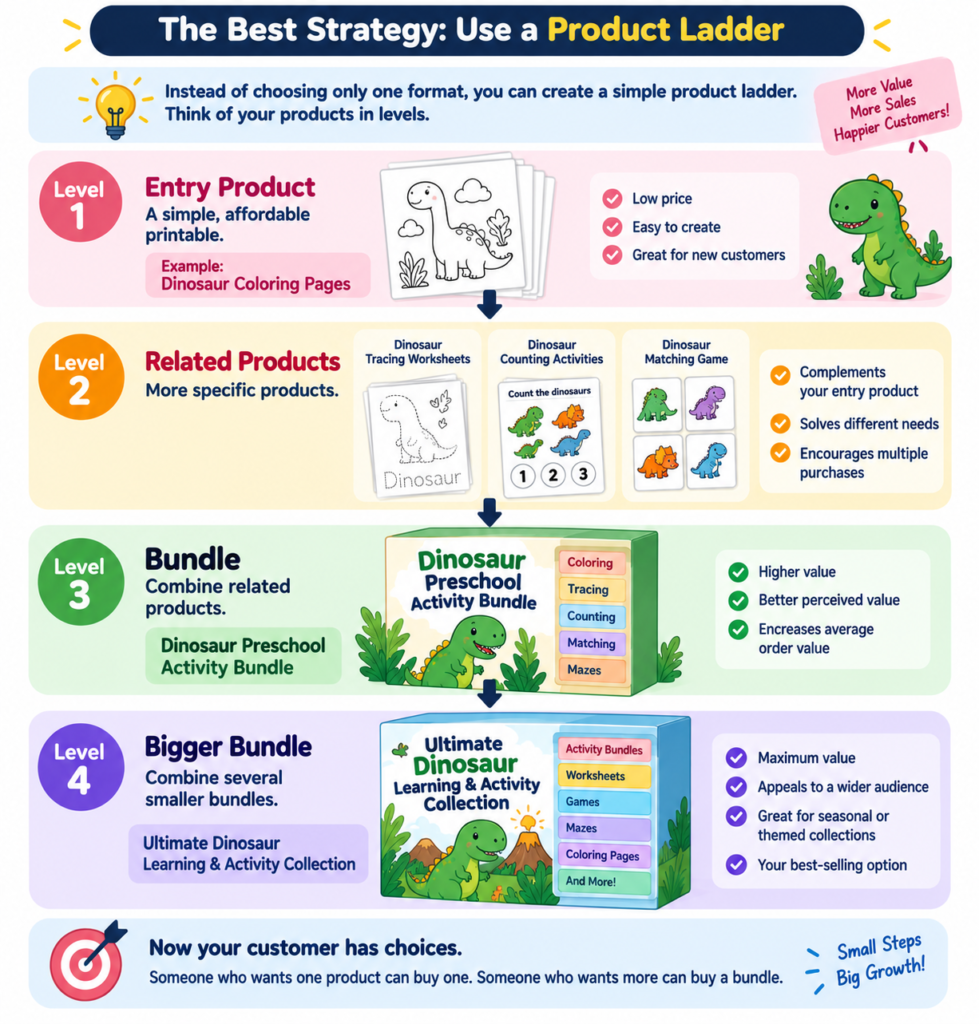
Instead of choosing only one format, you can create a simple product ladder.
Think of your products in levels.
Level 1: Entry Product
A simple, affordable printable.
Example:
Dinosaur Coloring Pages
Level 2: Related Products
More specific products.
Dinosaur Tracing Worksheets
Dinosaur Counting Activities
Dinosaur Matching Game
Level 3: Bundle
Combine related products.
Dinosaur Preschool Activity Bundle
Level 4: Bigger Bundle
Combine several smaller bundles.
Ultimate Dinosaur Learning & Activity Collection
Now your customer has choices.
Someone who wants one product can buy one.
Someone who wants more can buy a bundle.
This Is Why You Shouldn’t Delete Your Single Products After Creating a Bundle
A common mistake is thinking:
“Now that I have a bundle, I should remove all the individual products.”
Not necessarily.
Your individual products can continue serving a purpose.
Someone might only need one worksheet.
Someone else might want the complete collection.
Having both gives customers different ways to buy.
For example:
Customer A
“I only need a dinosaur scavenger hunt.”
→ Buys the single product.
Customer B
“I want several dinosaur activities.”
→ Buys the bundle.
Customer C
“I want everything.”
→ Buys the larger collection.
You’re giving customers options based on their needs and budget.
How to Turn Your Best Sellers Into Bundles
This is one of the strategies I’d recommend trying once your shop has enough products.
Look at your existing products.
Which ones are:
- Getting views?
- Getting favorites?
- Getting sales?
- Clearly related?
- Popular with the same audience?
Then look for patterns.
For example:
You notice that your:
Dinosaur Coloring Pages
and
Dinosaur Tracing Worksheets
are both performing well.
Then you add:
Dinosaur Counting Worksheets
and
Dinosaur Matching Game.
Now you have enough related content to create:
Dinosaur Preschool Activity Bundle
Instead of guessing what to put inside the bundle, you’re building it from products you’ve already tested.
Don’t Make Your Bundle Too Broad
Let’s say your shop sells preschool printables.
You might have:
- Alphabet
- Numbers
- Shapes
- Colors
- Animals
- Holidays
You could theoretically combine all of them into one enormous bundle.
But that doesn’t necessarily make it a good product.
Instead, create smaller, more logical bundles.
Alphabet Bundle
Includes:
- Letter tracing
- Letter matching
- Alphabet coloring
- Beginning sounds
Numbers Bundle
Includes:
- Number tracing
- Counting
- Number matching
- Number coloring
Animal Bundle
Includes:
- Animal coloring
- Animal matching
- Animal counting
- Animal puzzles
Then potentially:
Ultimate Preschool Bundle
Combines the smaller collections.
Now the customer has a logical progression.
How to Price a Bundle
This is where you should think about value, not simply page count.
Let’s say you have four products:
- Product A — $3
- Product B — $3
- Product C — $4
- Product D — $4
Buying them individually would total $14.
You could create a bundle at a lower combined price.
For example:
Individual total: $14
Bundle: $9.99
The exact pricing should depend on your market, product quality, customer value, and costs.
Etsy’s own guidance recommends considering your creation time, expenses, desired profit, and market research when setting prices. (Etsy)
The important point is:
Don’t price your bundle purely based on the number of pages.
Think about what the customer is actually receiving.
Don’t Undervalue Your Digital Products
Another mistake new sellers make is thinking:
“It’s only a PDF, so it has to be cheap.”
But customers aren’t necessarily paying for the file itself.
They’re paying for:
- The time you saved them
- The problem you solved
- The organization
- The design
- The convenience
- The ideas
- The finished resource
A parent buying a ready-to-use activity bundle isn’t simply paying for paper.
They’re paying for something they don’t have to create themselves.
That is the value.
What About Etsy Fees?
When comparing singles and bundles, don’t only look at the listed price.
You need to consider your actual costs and Etsy’s applicable fees.
For digital listings, Etsy allows sellers to upload up to five files per digital listing, with a maximum of 20 MB per file. (Etsy Help)
That means your bundle also needs to be organized properly.
If your bundle contains many files, you may need to package them appropriately, such as using ZIP files where suitable.
Make sure your customer knows exactly what they will receive.
Organize Your Bundle Like a Product
Don’t just dump files into a folder.
Create a professional experience.
For example:
Dinosaur Preschool Bundle
01 — Coloring Pages
02 — Tracing Activities
03 — Counting Worksheets
04 — Matching Games
05 — Mazes
06 — Bonus Activities
You could also include a simple:
“Start Here” PDF
with:
- What’s included
- Printing instructions
- Recommended age
- File information
- How to access the files
The easier your product is to understand and use, the better the customer experience.
Make Your Listing Images Do the Selling
A bundle can be difficult to communicate because there is so much inside it.
That’s why your listing images matter.
Etsy currently allows up to 20 photos and two short videos on a listing, giving sellers plenty of space to show what a product includes. (Etsy Help)
For a bundle, don’t just create one cover image saying:
100+ PAGES!
Instead, show the customer what they actually receive.
For example:
Image 1
Dinosaur Preschool Activity Bundle
Image 2
What’s Included
Image 3
Coloring activities
Image 4
Tracing activities
Image 5
Counting activities
Image 6
Matching games
Image 7
Mazes and puzzles
Image 8
Age + format + printing information
This makes the value much easier to understand.
Your First Image Should Answer One Question
When someone sees your thumbnail, they should quickly understand:
What is this?
Don’t make your thumbnail so busy that the customer has to zoom in to figure it out.
For example:
❌“THE ULTIMATE MASSIVE MEGA SUPER BUNDLE!!!”
Better:
Dinosaur Preschool Activity Bundle
Coloring • Tracing • Counting • Games
Simple.
Clear.
Readable.
Singles Can Be Better for SEO Testing
Here’s another reason I like starting with individual products.
They allow you to test different search intents.
For example:
Product 1
Dinosaur Coloring Pages
Product 2
Dinosaur Preschool Worksheets
Product 3
Dinosaur Activity Pack
Product 4
Dinosaur Tracing Worksheets
Each product can target a different customer need.
Then you can see which concepts attract attention.
Etsy’s listing system lets sellers add tags, attributes, descriptions, and other listing information to help describe their products. (Etsy Help)
That gives you more opportunities to learn which product ideas resonate with your audience.
Bundles Can Be Great for Increasing Customer Value
Once you’ve established demand, bundles can help you encourage customers to purchase more at once.
Think of it like this:
Single Product
Customer spends $3.
Bundle
Customer spends $10.
Larger Bundle
Customer spends $18.
You aren’t forcing the customer to buy the most expensive option.
You’re giving them choices.
This is similar to Etsy’s broader guidance around tiered product offerings and complementary bundles: offering related products together can give shoppers another way to purchase more complete sets. (Etsy)
A Simple Example for a Kids Printable Shop
Let’s imagine you sell preschool printables.
You could build your shop like this:
Individual Products
Alphabet Tracing Worksheets — $3
Number Worksheets — $3
Shape Matching Game — $3
Preschool Coloring Pages — $3
Animal Matching Game — $4
Small Bundles
Alphabet Activity Bundle — $7
Numbers & Counting Bundle — $7
Animal Activity Bundle — $8
Larger Bundle
Ultimate Preschool Learning Bundle — $15–$20
Now you have several different price points.
Someone looking for one simple activity has an option.
Someone who wants more has another.
And someone who wants a complete collection has a third.
What If Nobody Buys the Bundle?
Don’t immediately assume the bundle is bad.
First, ask:
Is the bundle clearly explained?
Maybe customers don’t understand what’s included.
Does the thumbnail communicate the value?
Maybe the product looks confusing.
Is the bundle too expensive compared with similar products?
Maybe the pricing needs testing.
Is the bundle too broad?
Maybe the products don’t feel connected.
Do customers actually want all the products together?
This is important.
A bundle isn’t automatically valuable just because you put more products inside it.
What If Nobody Buys Your Single Printable?
The same principle applies.
Don’t immediately conclude that the product itself is useless.
Look at the entire listing.
Maybe:
- The thumbnail isn’t strong.
- The title isn’t clear.
- The product is too generic.
- The listing doesn’t explain the benefits.
- The niche is too broad.
- The price doesn’t fit the market.
- The product isn’t reaching the right audience.
Treat poor performance as information.
Don’t treat it as an immediate verdict on your ability to create products.
One of the Best Strategies: Create Singles First, Bundle Later
If you’re a beginner, this is probably the strategy I’d recommend most.
Instead of spending two weeks creating one enormous 150-page bundle, start smaller.
Create several related products.
For example:
Week 1
Dinosaur Coloring Pages
Week 2
Dinosaur Tracing Worksheets
Week 3
Dinosaur Counting Activities
Week 4
Dinosaur Matching Game
Week 5
Dinosaur Mazes
Then:
Week 6
Combine them into:
Dinosaur Preschool Activity Bundle
Now you’ve created:
5 individual products + 1 bundle
rather than just one giant product.
More importantly, you’ve learned what goes into your bundle before putting everything together.
The “Build → Test → Bundle” Strategy
Here’s the complete strategy in three words:
1. Build
Create individual products around a clear audience or niche.
2. Test
Watch what happens.
Look at:
- Views
- Favorites
- Sales
- Customer interest
- Search terms
- Which products get attention
3. Bundle
Combine related products into a more complete solution.
This creates a natural product-development cycle.
Don’t Forget Cross-Selling
Once you have several related products, your individual listings can point customers toward related products.
For example:
At the end of your product description, you could say:
Looking for more dinosaur activities? Check out the complete Dinosaur Preschool Bundle.
Now the single product becomes an entry point into the larger collection.
And your bundle can mention:
Prefer to start small? Individual activities are also available in our shop.
You’re creating a connected product ecosystem.
Which Is Better for Beginners?
If you’re completely new to Etsy, I’d personally avoid making your entire strategy dependent on huge bundles.
Start with manageable products.
Why?
Because you’re still learning:
- How to create digital products
- How to design thumbnails
- How to write listings
- How Etsy search works
- What your audience likes
- How customers respond
You don’t need to spend enormous amounts of time creating one product before you’ve learned whether the concept works.
Start small.
Learn.
Then scale.
Which Makes More Money in the Long Run?
If I had to simplify it:
Single printables can help you:
Get discovered → test ideas → build listings → attract first-time buyers
Bundles can help you:
Increase value → increase order size → package related products → serve customers who want more
That’s why I wouldn’t think of them as competitors.
Think of them as different stages of the same customer journey.
The Etsy Shop Strategy I’d Use
A Simple Product Ladder You Can Copy
Here’s an example you could use for a kids printable Etsy shop:
$2–$4
Single Printable
↓
$5–$8
Mini Bundle
↓
$9–$15
Themed Bundle
↓
$15–$25+
Complete Collection
The exact prices are not rules.
Your pricing should be based on your niche, competition, product quality, customer value, and costs.
The purpose of the ladder is simply to give customers different ways to buy.
Don’t Forget: The Product Must Be Original
If you’re selling digital products on Etsy, make sure you understand Etsy’s current creativity standards.
Etsy states that digital items listed in your shop must be made and/or designed by you, the seller. (Etsy Help)
So don’t build a bundle by simply collecting files you don’t have the right to sell.
A bundle should represent your own original product collection and comply with Etsy’s policies and any applicable licenses for third-party assets you use.
Single Printables vs. Bundles: My Final Verdict
So…
Which makes more money?
Neither one automatically wins.
The better strategy is to use both strategically.
If you’re just starting:
Start with single printables.
They’re easier to create, easier to test, and easier for customers to try.
Then, as your product collection grows:
Turn related products into bundles.
This gives customers a higher-value option while allowing you to keep your individual products available.
Think of it like this:
Singles help you build the foundation.
Bundles help you package that foundation into bigger solutions.
And when you combine the two, you don’t have to choose between getting more listings and increasing the value of each order.
You can work toward both.
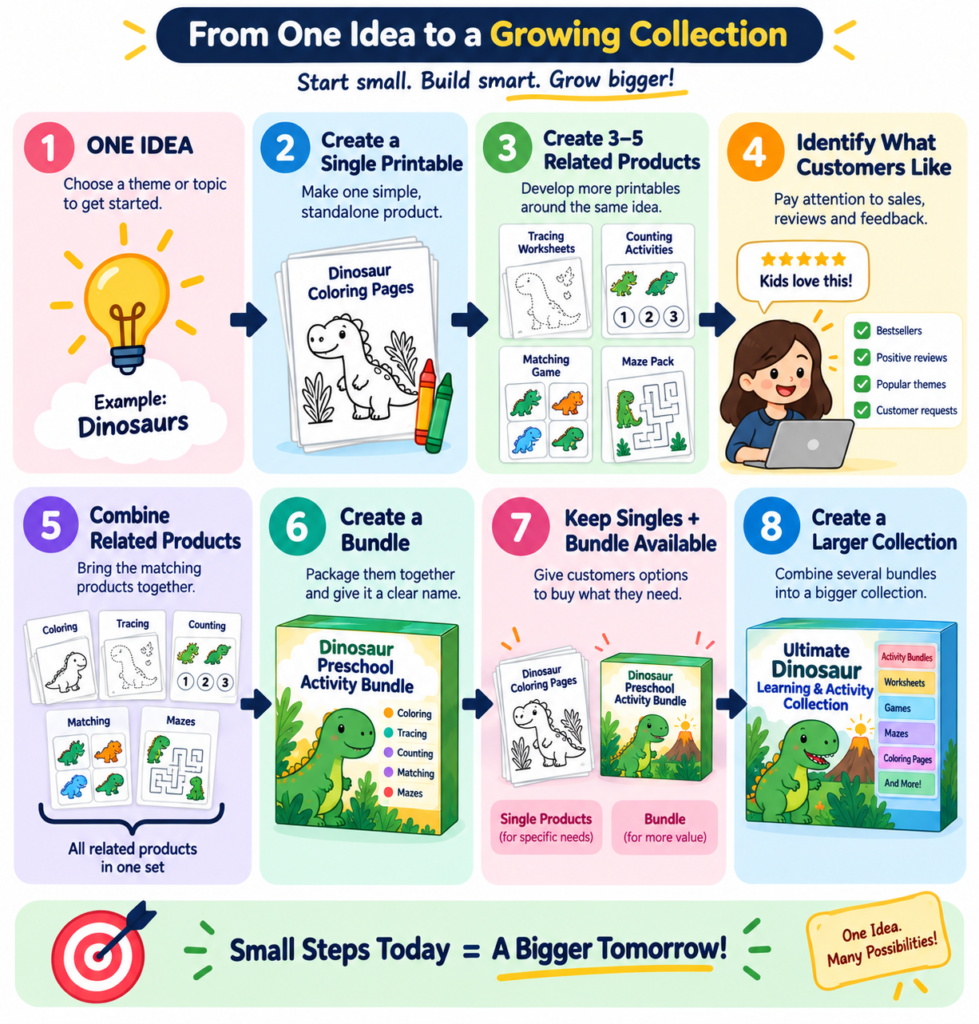
Your Etsy Product Strategy in One Simple Diagram
ONE IDEA
↓
Create a Single Printable
↓
Create 3–5 Related Products
↓
Identify What Customers Like
↓
Combine Related Products
↓
Create a Bundle
↓
Keep Singles + Bundle Available
↓
Create a Larger Collection
That’s a much more sustainable way to build a digital product shop than trying to guess your “perfect” mega-bundle on day one.
🎁 Want More Digital Product Ideas?
If you’re currently brainstorming what to sell on Etsy, don’t limit yourself to just one product type.
I’ve put together 50 digital product ideas that can help you find different products, niches, and directions for your Etsy shop.
You can use them to brainstorm:
- Kids’ printables
- Educational resources
- Planners
- Worksheets
- Templates
- Activity books
- Seasonal products
- Business printables
- And more
Get the Free 50 Digital Product Ideas
Don’t try to create all 50.
Pick one promising idea.
Research it.
Create a simple version.
Test it.
Then decide whether it deserves more products or a bundle.
🎥 Want to See the Etsy Journey Behind the Strategy?
If you’re following my 6-Week Etsy Challenge, you can also watch the complete journey to see how a digital product shop developed from the beginning—including the process of creating products, improving the shop, getting sales, and testing different strategies.
Watch the Full 6-Week Etsy Challenge
The biggest lesson from the challenge wasn’t simply how many sales happened.
It was learning how to create, test, improve, and build on what worked.
And that’s exactly how I’d approach singles and bundles.
Don’t guess.
Build → Test → Learn → Bundle → Improve.
📝 Would You Take an Etsy Course?
If you’re following this series and you’re thinking:
“I wish someone would just walk me through all of this step by step.”
I’m considering creating a structured Etsy course covering the complete process—from finding a product idea to setting up the shop, creating listings, learning Etsy SEO, and working toward those first sales.
But before creating it, I want to know what you actually want to learn.
Take the Quick Etsy Course Survey
Tell me which topics would be most useful to you and what you’re currently struggling with.
Your answers will help shape the course around real questions and real problems, rather than simply creating another generic Etsy course.
Final Thoughts
If you’re new to selling digital products on Etsy, don’t feel like you have to choose between single printables and bundles.
You can start small.
Create one useful product.
Then another.
Then another.
Eventually, you’ll have enough related products to create something bigger.
And that’s when your individual products become more than individual listings.
They become the building blocks of your Etsy shop.
So if you’re wondering what to make first, here’s my advice:
Don’t start by asking, “How big can I make my bundle?”
Start by asking:
“What is one useful product I can create for one specific customer?”
Create that.
Test it.
Learn from it.
Then build the next product.
Because the best bundle might not be the product you start with.
It might be the product you build toward.